 Teambuilding-Kompass
Key points at a glance
- The Tuckman model describes how groups develop into teams. Bruce Tuckman formulated four stages in 1965; in 1977 he added the fifth together with Mary Ann Jensen.
- The 5 stages: forming (orientation), storming (friction), norming (rules), performing (performance), adjourning (completion).
- Each stage calls for a different leadership role – from providing clear direction to letting go.
- Storming is uncomfortable but necessary. Teams that skip it often end up in a false harmony.
- Teams can fall back into earlier stages at any time, for example because of new members or restructuring.
The Tuckman model: origins and basic idea
In the mid-1960s, the American psychologist Bruce W. Tuckman reviewed studies on small groups and found that many groups go through similar stages of development. In 1965 he published his model with the four catchy stages forming, storming, norming and performing. In 1977, together with Mary Ann Jensen, he added a fifth stage, adjourning – the end of a team.
The basic idea is simple: a group of people doesn't become a team because of an organisation chart. It first has to find its bearings, negotiate its relationships and power dynamics and develop shared norms – only then can it reach its full potential. The performance curve does not rise steadily along the way – in storming it often even dips before rising significantly in norming and performing.
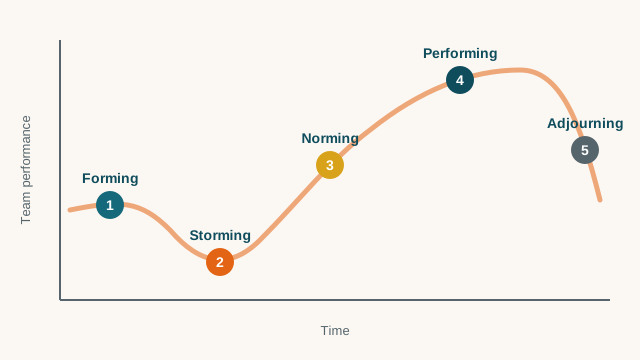
In practice, the model is particularly valuable as a map. It helps managers and teams to understand tensions not as personal failure but as an expected step in their development. And it gives an indication of which team building activities make sense at the moment.
Stage 1: Forming – orientation and politeness
A new team comes together, or an existing one is reorganised. The members feel each other out, are polite and rather reserved. Everyone is wondering: who are the others? What is expected of me? Where do I fit in?
Characteristics
- Friendly but superficial interaction; conflicts are avoided.
- High expectations combined with uncertainty.
- Strong focus on the manager; lots of questions about responsibilities.
- Performance is still low because processes and roles are missing.
Warning signs
- Even after weeks, the team sticks to small talk and avoids any discussion of substance.
- Individuals withdraw or only work on their own.
- Goals are understood differently without anyone noticing.
The manager's role
This stage calls for leadership that provides orientation and is fairly directive. The manager explains the goals and purpose of the task, introduces initial ground rules and creates opportunities for people to get to know each other. They are approachable and provide security without dictating everything.
Suitable team building activities
- Lifeline or personal map: quickly creates an understanding of backgrounds and experiences.
- Team profiles: working style, strengths and preferences at a glance.
- Cooperative building task in mixed groups: a relaxed experience in which first roles become visible.
- Eating or cooking together: an informal setting for conversations beyond work.
You will find short getting-to-know-you formats for meetings under team building games, and for distributed teams under virtual team building.
Stage 2: Storming – friction and jostling for position
As soon as the initial politeness has worn off, differences come to light: in working methods, expectations, values and demands. People compete for influence, responsibilities and recognition. To many, this stage feels as if something is going wrong – yet it is a necessary step.
Characteristics
- Open or hidden conflicts, cliques forming.
- Criticism of goals, methods or the leadership.
- Questions of power: who decides? Whose opinion counts?
- Performance often drops because a lot of energy goes into sorting out relationships.
Warning signs
- Conflicts become personal; people talk about each other rather than to each other.
- Individual members quit, either inwardly or for real.
- The team seems calm on the outside, but decisions are blocked or undermined – a sign of suppressed storming.
The manager's role
Now the manager is needed as a facilitator and coach. They should not push conflicts aside but create a safe framework in which they can be resolved objectively. This includes ground rules for discussions, active listening, transparent decisions and a willingness to accept criticism of themselves too. If positions have hardened or the manager is a party to the conflict, neutral external facilitation helps.
Suitable team building activities
- Facilitated conflict resolution: structured, with clear rules and neutral leadership.
- Communication exercises with reflection: for example tasks in which information is unevenly distributed.
- Role clarification: for example with a RACI matrix to defuse disputes over responsibilities.
- Feedback rounds with fixed rules: “I” statements, concrete observations, no judgements.
Avoid highly competitive events during storming. People who are already struggling for position quickly experience a game with winners and losers as confirmation of existing rifts. Cooperative tasks with a shared result work much better.
We describe in detail how to structure such a clarification process as a workshop in our article team building workshop: agenda and methods. With deeper-seated conflicts, support over several sessions is often more useful than a single workshop – for example team coaching that also works with the Tuckman model and accompanies conflicts over several weeks.
Stage 3: Norming – rules and cohesion
Once the team has worked through the friction of the storming stage constructively, a shared understanding of how it wants to work together emerges. Rules are negotiated, roles accepted, and a sense of “us” develops.
Characteristics
- Shared norms and ways of working are agreed and observed.
- Roles are clear, and members support each other.
- Feedback is given and accepted more openly.
- Performance rises noticeably.
Warning signs
- Groupthink: criticism is avoided for fear of jeopardising the new harmony.
- New ideas from outside or from new members are rejected.
- Rules become an end in themselves and hamper flexibility.
The manager's role
The manager becomes a supporter. They hand over responsibility, encourage the team to formulate its own rules and make sure that there is still room for constructive criticism. Appreciation for what has been achieved strengthens the new stability.
Suitable team building activities
- Team canvas or team agreement: makes norms visible and binding.
- Values workshop: translates shared values into concrete behaviour.
- Cooperative building tasks: such as bridge building or a chain reaction, where coordination determines success.
- Regular retrospectives: keep reflection alive and prevent groupthink.
You can read which rules have proven themselves in practice in our article on the golden rules for good teamwork. You will find ideas for cooperation tasks in a room under indoor team building.
Stage 4: Performing – performance and independence
The team works smoothly, flexibly and largely self-organised. Energy goes into the task rather than into relationship issues. Differences are used as a resource, and conflicts are resolved objectively and quickly.
Characteristics
- High performance, a high degree of personal responsibility.
- Roles are swapped flexibly depending on the task.
- Open communication, including about mistakes.
- The team can handle challenges largely without the manager.
Warning signs
- Routine and lack of challenge: the team becomes complacent or loses motivation.
- Overload: because things are going well, more and more work is piled onto the team.
- Isolation from other teams or departments.
The manager's role
The manager delegates and clears the way. They provide resources, protect the team from overload, set ambitious goals and invest in development and recognition. Micromanagement would be particularly damaging at this stage.
Suitable team building activities
- Demanding challenges: complex tasks that stretch the team and test its limits.
- Hackathon or idea sprint: working on a real challenge facing the company.
- Cross-team formats: shared tasks with other departments to counter silo thinking.
- Appreciation event: celebrate successes, for example with a shared outdoor experience.
For high-performing teams, team building activities by BITOU that combine experience and reflection are particularly suitable – for example formats in which several teams build modules of a joint construction and have to coordinate the interfaces.
Stage 5: Adjourning – completion and farewell
Projects end, teams are disbanded or restructured, members move on. The fifth stage, which Tuckman and Jensen added in 1977, describes this ending. It is often overlooked in practice – yet it shapes the feelings with which people move on to their next team.
Characteristics
- Tasks are completed and handed over.
- Mixed feelings: pride, relief, wistfulness, sometimes uncertainty about the future.
- Motivation can drop as soon as the end is in sight.
Warning signs
- The team falls apart before the work is finished.
- Knowledge is lost because there is no handover.
- An abrupt end without recognition leaves frustration behind.
The manager's role
The manager shapes the ending deliberately: they acknowledge the team's achievements, secure knowledge, give individual feedback and support members in the transition to new tasks.
Suitable team building activities
- Closing retrospective: what have we learnt, and what do we pass on?
- Lessons-learned documentation: secure knowledge for follow-up projects.
- Appreciation round: each person receives personal recognition.
- Farewell celebration: a shared ritual that visibly marks the end.
The 5 stages of team development at a glance
| Stage | Mood in the team | Leadership role | Suitable activities |
|---|---|---|---|
| Forming | polite, uncertain, wait-and-see | provide orientation | getting to know each other, profiles, relaxed cooperation tasks |
| Storming | tense, critical, full of conflict | facilitate, secure the framework | conflict resolution, role clarification, feedback with rules |
| Norming | confident, connected | support, hand over responsibility | team canvas, values workshop, cooperation tasks |
| Performing | self-assured, well-practised | delegate, secure resources | challenges, hackathon, cross-team formats |
| Adjourning | proud, wistful | shape the ending, give recognition | closing retro, appreciation, farewell celebration |
Self-test: which stage is my team in?
Read the statements and note which ones best apply to your team. The stage with the most matches gives an indication of where your team currently stands. It is even more revealing if all team members complete the test anonymously and you discuss the results together.
| Statement about your team | Indicates |
|---|---|
| We are friendly to each other but know little about how the others work. | Forming |
| Many questions are directed at the manager instead of being resolved within the team. | Forming |
| There are frequent discussions about who is responsible for what. | Storming |
| There are noticeable tensions or conspicuous silences in meetings. | Storming |
| We have shared rules that most people stick to. | Norming |
| We give each other feedback but sometimes avoid uncomfortable topics. | Norming |
| We solve problems largely on our own and switch roles depending on the task. | Performing |
| Conflicts are resolved quickly and objectively, without lingering on. | Performing |
| Our project is ending soon, and our thoughts are already turning to new tasks. | Adjourning |
| Members are leaving the team, and tasks are being handed over. | Adjourning |
That's normal. A team can be performing on routine tasks and storming on a new project. Look at where the emphasis lies – and at whether the assessments within the team differ widely. Large differences are an important topic for discussion in themselves.
Falling back into earlier stages
The Tuckman model is often presented as a one-way street. In reality, teams keep jumping back. Typical triggers are:
- New team members: the group has to reorient itself – a bit of forming starts all over again.
- Change of manager: expectations and power dynamics are renegotiated, which can trigger storming.
- Changed goals or structures: established rules no longer fit and need to be readjusted.
- Heavy workload or crises: under pressure, old conflicts flare up again.
- A switch to working from home or hybrid working: communication routines suddenly stop working.
A setback is not a failure. What matters is recognising it and naming it openly. Often it is enough to consciously clarify roles, rules and goals again – for example in a short workshop. In the case of major upheavals, structured team development with role clarification and reflection, such as BITOU offers as a multi-stage process, is worthwhile.
Criticism and limitations of the Tuckman model
As helpful as the model is, it is a simplification. Anyone who uses it should know its limits.
- Linearity: in practice, the sequence is less rigid. Stages overlap, are skipped or repeated.
- Original data basis: Tuckman relied mainly on studies of therapy, training and laboratory groups, not on modern project teams in companies.
- No time frames: the model says nothing about how long a stage lasts or should last.
- Missing context: corporate culture, the task, time pressure and organisational structure are largely ignored.
- New ways of working: distributed, agile and constantly re-forming teams only partly fit the classic pattern.
Other models broaden the perspective, for example approaches that link team development more closely to the milestones of a project, or team role models that look at the composition of the team. For everyday use, however, Tuckman remains a valuable tool for conversation: it gives teams a shared language for talking about their development – and that alone is often an important step.
How to use the stage model in everyday work
- Assess togetherIntroduce the model to the team and let everyone assess where the team stands, for example with the self-test above or a team clock.
- Discuss differencesAsk for examples: what is your assessment based on?
- Choose a suitable activityUse the overview above to find an activity that fits the current stage.
- Repeat regularlyA short check of where you stand every three to six months reveals developments and setbacks early on.
Plan the budget, time frame and schedule of a suitable activity with our guide to team building planning and costs.
Frequently asked questions about the stages of team development
What are the 5 stages of team development?
According to Bruce Tuckman, teams go through the stages of forming (orientation), storming (conflict and jostling for position), norming (shared rules and cohesion), performing (independent, high-performing collaboration) and adjourning (completion and disbanding). Tuckman described the first four stages in 1965 and added the fifth together with Mary Ann Jensen in 1977.
How long do the stages of team development last?
There is no fixed duration. Some teams go through forming and storming in a few weeks, others remain stuck in one stage for months. What matters is the size of the team, how stable its membership is, how clear the goals are and how consciously the manager and the team guide its development.
Can a team fall back into an earlier stage?
Yes. New team members, a change of manager, changed goals or heavy workloads can throw an established team back into forming or storming. This is normal and not a failure. It helps to name the setback openly and to consciously clarify rules and roles again.
Which stage of team development is the most difficult?
Most teams and managers experience storming as the most difficult stage, because conflicts, power issues and dissatisfaction become visible. At the same time, it is necessary: resolving tensions constructively at this stage lays the foundation for genuine trust and stable collaboration.
What does the manager do in the storming stage?
In the storming stage, the manager should not suppress conflicts but create a safe framework for resolving them: agree on ground rules for discussions, listen to different points of view, explain decisions transparently and bring in neutral facilitation if positions have become entrenched.
You might also be interested in
Team building workshop
Agendas and 12 methods – from role clarification to the team agreement.
Workshop agenda →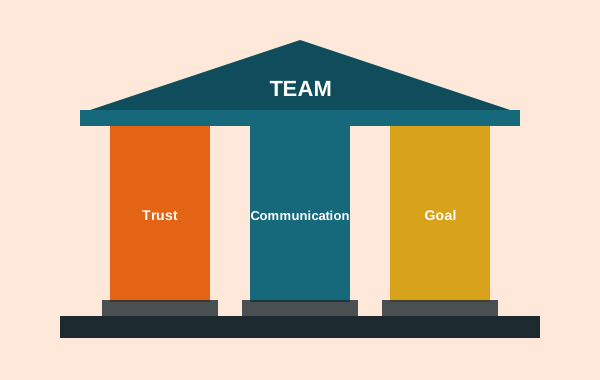
Rules for good teamwork
The 10 golden rules and 3 pillars – the basis for the norming stage.
Read the rules →
Virtual team building
Ideas for remote and hybrid teams at every stage of development.
Remote ideas →
Written by Joachim Grittmann, BITOU GmbH. For more than 20 years, BITOU has been designing and facilitating team building activities, team events and team development for groups of 10 to more than 3,000 people – experience from this practice feeds into the Teambuilding-Kompass.