 Teambuilding-Kompass
Key points at a glance
- Successful teamwork rests on three pillars: trust, communication and a shared goal.
- The 10 golden rules for good teamwork translate these pillars into concrete behaviour – from clarifying goals to regular reflection.
- The most important success factor is psychological safety: everyone may ask questions, express doubts and admit mistakes.
- Rules only work if the team formulates them itself – use our team agreement as a template.
- Targeted team building activities make rules tangible and help to anchor them in everyday work.
The 3 pillars of teamwork
Before looking at individual rules, it is worth taking a look at the foundations. Whether it is a software development project team, a hospital ward or a sales team: collaboration works well when three things are present at the same time. If one of these pillars is missing, the whole building wobbles – regardless of how strong the individual members are professionally.
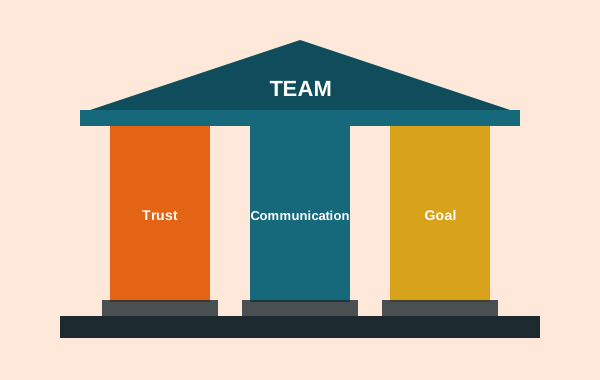
Pillar 1: Trust
Trust in a team has two sides. On the one hand, there is trust in reliability: I can rely on my colleague to deliver her part on time and to a good standard. On the other, there is trust in the person: I know that nobody will embarrass me if I admit a gap in my knowledge. Both grow slowly and can be destroyed quickly – by broken promises just as much as by a disparaging comment in a meeting.
Pillar 2: Communication
What matters is not the number of messages but their quality. Good team communication means that information reaches the people who need it, expectations are voiced rather than assumed, and problems are named early. Many teams suffer less from too little communication than from disorganised communication – too many channels, unclear responsibilities, decisions that disappear somewhere in the chat.
Pillar 3: A shared goal
A team without a shared goal is just a working group. Only when everyone knows what they are working together for and how success is measured can they align priorities and negotiate conflicting goals openly. The goal should be concrete enough to guide decisions in everyday work – “We want to be good” is not enough.
Ask your team to rate each pillar anonymously on a scale of 1 to 5. The pillar with the lowest average score is your starting point – and sets the direction for your next team building activity.
The 10 golden rules for good teamwork
The following rules for good teamwork are not rigid commandments but proven guard rails. For each rule you will find a short explanation, an example from everyday working life and a team building activity that brings the topic to life.
1. Agree on a shared goal
Every team member should be able to describe the goal in their own words. If the answers sound very different, this is the first area to work on. A good team goal is verifiable, time-bound and relevant to everyone.
Practical example: a marketing team regularly argues about priorities. A conversation reveals that one half is optimising for reach, the other for qualified enquiries. Only once the team has agreed on a shared metric do the discussions become shorter and more objective.
Suitable team building activity: a building or planning task in which several small groups work on a shared result. In the Future City 4.0 format, for example, teams jointly develop a model of a city of the future – anyone who loses sight of the big picture will notice at the latest when the pieces are put together.
2. Define roles and responsibilities
Unclear responsibilities are one of the most common causes of friction. If several people believe a task belongs to them – or nobody does – the result is duplicated work and gaps. So clarify who decides, who contributes and who needs to be informed.
Practical example: in an IT project, customer enquiries are emailed to three people. Each one waits for someone else to reply. A simple responsibility matrix listing exactly one responsible person for each task solves the problem within a week.
Suitable team building activity: cooperation games with limited resources in which the team has to allocate positions and tasks itself. In Team 11, groups use a budget to put together their own football team and then compete in a tournament – role allocation and strategy become visible immediately.
3. Communicate openly and respectfully
Openness means raising things before they become problems. Respect means criticising the issue, not the person. Together, they make it possible to speak plainly without hurting feelings. “I” statements help (“I'm still waiting for the sign-off”) rather than accusations (“You've forgotten again …”).
Practical example: a team leader notices that the same three people always do the talking in meetings. He introduces a short round at the start in which everyone gives their update in turn. After a few weeks, the quieter colleagues also speak up of their own accord more often.
Suitable team building activity: exercises in which a message has to be conveyed precisely, for example back-to-back drawing or a blindfold course. You will find many more ideas in our collection of short team building games for adults.
4. Listen actively
Listening is more than staying quiet until it's your turn again. Active listening means asking questions, summarising and putting your own point of view on hold for the moment. This ability is quickly lost, especially in discussions under time pressure.
Practical example: in a customer service department, a new rule applies: before anyone contradicts a suggestion, they summarise it in one sentence. At first this slows the discussion down, but it prevents many misunderstandings.
Suitable team building activity: conversation exercises in pairs with fixed roles (telling, listening, summarising) or a team hike with reflection stops at which the pairs keep changing.
5. Keep your commitments and build trust
Trust is built through many small promises that are kept. If you promise to deliver by Thursday, you deliver by Thursday – or let people know in good time if it isn't going to work. In everyday work, this reliability is often more important than grand gestures.
Practical example: a distributed team introduces a simple board on which each person enters their commitments for the week. It's not about control but transparency. Anyone who realises they won't manage says so in the stand-up – and receives support instead of criticism.
Suitable team building activity: tasks in which each person is responsible for part of the overall result, such as raft building or outdoor cooperation tasks. Our article on outdoor team building collects ideas for this.
6. Give and accept feedback
Feedback is the input without which no team gets better. Good feedback is specific, timely and describes behaviour and its effect. It is just as important to be able to accept feedback without immediately justifying yourself – a simple “Thanks, I'll think about that” is often enough.
Practical example: a project group ends every sprint with five minutes of “plus/delta”: what worked well, and what should we change? Because the format is a fixed part of the schedule, nobody feels personally attacked.
Suitable team building activity: an appreciation round in which each person receives specific positive feedback is a gentle way in. For critical feedback, a facilitated team building workshop with clear ground rules is a good fit.
7. Resolve conflicts early and objectively
Conflicts are normal and can even move a team forward – as long as they are about content. Things become problematic when tensions are ignored and shift to the personal level. The earlier a conflict is addressed, the easier it is to resolve.
Practical example: two senior developers have been blocking each other on architecture decisions for weeks. Instead of waiting, the team leader invites both to a facilitated conversation in which the shared goals are discussed first, followed by the differing assumptions. The result is a decision-making rule for future cases.
Suitable team building activity: a purely fun event tends to cover up conflicts rather than resolve them. Where tensions have become entrenched, neutral team coaching with external support is usually the better way. We describe typical conflict patterns for each team stage in our article on the stages of team development.
8. Share knowledge
Knowledge that sits in only one person's head is a risk for the whole team. Passing on experience, contacts and tricks of the trade makes the team more resilient to holidays, illness and resignations – and signals that collaboration matters more than individual success.
Practical example: a sales team introduces a monthly 30-minute “learning round”: one person presents a deal that was won or lost and explains what they learnt from it. As a result, new team members find their feet noticeably faster.
Suitable team building activity: puzzle and escape formats in which each group has only part of the information and the result can only be achieved by sharing. Such formats are also available online for remote teams – find out more under virtual team building.
9. Celebrate successes together
In many teams, one project follows the next without achievements being acknowledged. Yet celebrating consciously strengthens team spirit and makes visible what the effort was worth. Celebrating doesn't necessarily mean a party – a sincere thank-you in the team meeting counts too.
Practical example: after a difficult system migration, a head of department invites the team to breakfast together and tells the story of the project from her perspective – including the moments when individual people made the difference.
Suitable team building activity: a cooking event or a murder mystery dinner. You will find weather-independent ideas in our overview of indoor team building.
10. Reflect on your collaboration regularly
The last rule keeps all the others alive. Teams that pause at regular intervals and ask “How are we actually working together?” spot problems earlier and adapt their rules to changing conditions. Without reflection, team rules quickly turn into a forgotten document.
Practical example: an administrative team adopts the retrospective from agile software development: once a month, three questions are discussed in 45 minutes – what to keep, what to drop, what to try? The results feed directly into the team agreement.
Suitable team building activity: every good team building activity ends with a debriefing. Professionally facilitated team building activities with a follow-up reflection combine the shared experience with concrete insights for everyday work.
Psychological safety: the invisible success factor
The term psychological safety was shaped above all by Harvard professor Amy Edmondson. She uses it to describe the shared belief in a team that people can take interpersonal risks: asking a supposedly stupid question, admitting a mistake, voicing an idea that is not yet fully formed, or disagreeing with the manager. Edmondson came across the topic while studying hospital teams and found that well-functioning teams did not necessarily make fewer mistakes – they simply talked about them more openly and were therefore able to learn from them.
The concept became known to a wider public through Google's Project Aristotle. In this internal study, the company wanted to find out what distinguishes its most successful teams. The result: it was less the composition of the team and more the way it worked together that made the difference. Psychological safety proved to be the most important of five dynamics – alongside dependability, structure and clarity, meaning of the work, and the belief that one's work has an impact.
An important distinction: psychological safety does not mean that everyone is always nice to each other or that performance doesn't matter. On the contrary – only in a safe climate can high standards be negotiated openly without fear paralysing communication.
How to foster psychological safety in everyday work
- Actively ask for opposing views: “What are we overlooking right now?”
- Respond to bad news with thanks rather than anger – otherwise it will arrive too late in future.
- As a manager, admit your own mistakes and uncertainties.
- Explicitly frame new tasks as a learning opportunity in which mistakes are expected.
- Consistently put a stop to disparaging comments, even if they are meant as a joke.
Playful team building activities lower the barrier to making mistakes and laughing about them. Use the debriefing afterwards to build the bridge deliberately: “How do we deal with mistakes in our everyday work – and what can we take away from the game?”
Signs of good and bad teamwork
How can you tell where your team stands? The following comparison helps with an honest assessment. The truth usually lies somewhere in between – what matters is the direction of travel.
| Area | Good teamwork | Bad teamwork |
|---|---|---|
| Goals | Everyone knows the goal and can explain it | Everyone pursues their own priorities |
| Roles | Responsibilities are clear and accepted | Duplicated work, gaps, “That's not my job” |
| Meetings | Many voices, clear decisions | A few dominate, decisions remain open |
| Mistakes | Are reported early and analysed together | Are hidden, or people look for someone to blame |
| Conflicts | Objective, open, prompt | Below the surface, personal, via the grapevine |
| Knowledge | Is documented and passed on | Sits with individuals, knowledge monopolies |
| Feedback | Regular, specific, in both directions | Rare, vague or only in the annual review |
| Mood | Humour, mutual help, team spirit | Withdrawal, cynicism, doing the bare minimum |
If you recognise several points in the right-hand column, there is no reason to panic, but it is a reason to act. A facilitated team day with a clear objective is often a good first step. How to organise it and what it costs is explained in our guide to team building planning and costs.
Team agreement: template with sample rules
A team agreement (also known as a team charter or team rules) sets out how a team wants to work together. Its value lies less in the document than in the process: discussing rules together clarifies expectations that would otherwise remain unspoken.
Your own team agreement in five steps
- Collect experiencesEach person notes when they have experienced collaboration as particularly good or particularly difficult – in the current team or in previous ones.
- Identify patternsThe notes are clustered. Which behaviours come up again and again?
- Formulate rulesThe clusters are turned into concrete, observable rules. “We are respectful” is too vague; “We let each other finish speaking” can be checked.
- PrioritiseReduce the list to five to ten rules. Nobody remembers more than that.
- Make it visible and review itPut the agreement up in the team room or in the digital team channel and schedule a review session after four to six weeks.
Adapt the wording to your team – or use it as a basis for discussion.
- Goal: we start every quarter by looking at our goals together and check our priorities against them.
- Responsibility: every task has exactly one responsible person.
- Availability: we reply to messages in the team channel within one working day; urgent matters are dealt with by phone.
- Meetings: every meeting has an agenda and ends with recorded decisions and next steps.
- Letting others finish: we let each other finish speaking and ask questions before we disagree.
- Commitments: if we can't meet a deadline, we say so as soon as we know.
- Mistakes: we address mistakes openly. We look for causes, not culprits.
- Feedback: we voice criticism directly to the person concerned – not via third parties.
- Focus time: Tuesday and Thursday mornings are meeting-free times for focused work.
- Reflection: once a month we take 45 minutes for a retrospective.
The team agreement workshop can easily be combined with a short cooperation exercise as an opener. The experience provides shared observations on which the discussion about rules can be based.
The role of leadership in successful teamwork
Rules are created within the team – but whether they are lived depends heavily on the manager. Employees take their cue less from what is said than from what is modelled and tolerated. A manager who turns up to meetings unprepared will hardly be able to insist that meetings have an agenda.
For good teamwork, leadership takes on four main tasks:
- Provide direction: formulate goals and priorities clearly and repeat them regularly – even if it feels redundant.
- Protect the framework: ensure resources, focus time and realistic deadlines, and shield the team from outside disruptions.
- Lead by example: admit your own mistakes, ask for feedback, keep your commitments.
- Enforce the rules: address breaches in a friendly but timely way – otherwise rules quickly exist only on paper.
At the same time, leaders should not solve every difficulty themselves. Teams that learn to resolve conflicts and coordination issues on their own become more resilient. A sensible approach is: as much structure as necessary, as much self-organisation as possible. When a team needs more guidance and when it needs more freedom also depends on its stage of development.
For managers who have little time alongside their day-to-day business, one short team building activity per quarter plus an annual workshop can be a realistic rhythm. What matters is that every activity links to one of the rules or pillars – that is how a pleasant outing becomes a building block of team development.
Frequently asked questions about rules for good teamwork
What are the 10 golden rules of teamwork?
The 10 golden rules of teamwork are: 1. agree on a shared goal, 2. define roles and responsibilities, 3. communicate openly and respectfully, 4. listen actively, 5. keep your commitments and build trust, 6. give and accept feedback, 7. resolve conflicts early and objectively, 8. share knowledge, 9. celebrate successes together and 10. reflect on your collaboration regularly. The rules only become effective when the team formulates them together and reviews them in everyday work.
What are the 3 pillars of teamwork?
The 3 pillars of teamwork are trust, communication and a shared goal. Trust ensures that mistakes and ideas are raised openly. Communication makes information, expectations and problems visible. The shared goal gives everyone a direction and helps to set priorities. If one pillar is missing, collaboration becomes unstable.
What makes teamwork successful?
Successful teamwork is characterised by a clear goal that everyone supports, unambiguous roles, reliable agreements and an atmosphere in which everyone may ask questions, admit mistakes and disagree. Add to this regular reflection and a manager who provides direction and removes obstacles.
What does psychological safety in a team mean?
Psychological safety describes the shared belief in a team that people can take interpersonal risks without being embarrassed or punished for it – such as asking a question, admitting a mistake or voicing an uncomfortable opinion. The term was shaped above all by Harvard professor Amy Edmondson.
How do you create a team agreement?
A team agreement is best created in a facilitated session of 60 to 90 minutes: first the team collects good and bad experiences of working together, then these are turned into concrete, observable rules, prioritised together and reduced to five to ten points. The agreement is kept somewhere visible and reviewed and adjusted after a few weeks.
What should you do if someone doesn't stick to the team rules?
Address the behaviour promptly, specifically and in private, and refer to the jointly agreed team agreement rather than to personal traits. Ask about the reasons – often a rule is unclear or not workable in everyday practice. If breaches pile up across the whole team, the agreement itself belongs on the agenda of the next retrospective.
You might also be interested in
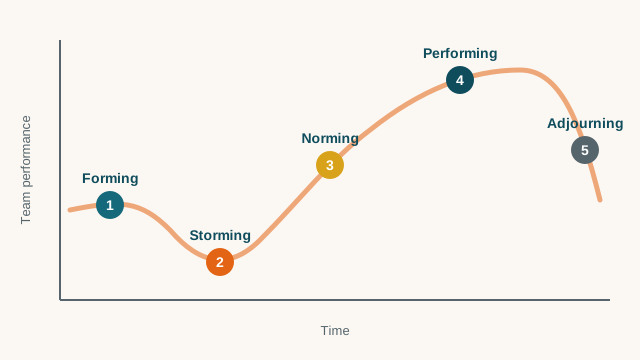
The 5 stages of team development
Forming to adjourning: how to recognise your team's stage and what helps now.
See the stages →
Team building workshop
Agenda and methods for workshops on roles, values and communication.
Plan a workshop →
Team building planning & costs
Checklist, cost overview per person and tips for choosing a provider.
Go to the checklist →
Written by Joachim Grittmann, BITOU GmbH. For more than 20 years, BITOU has been designing and facilitating team building activities, team events and team development for groups of 10 to more than 3,000 people – experience from this practice feeds into the Teambuilding-Kompass.