 Teambuilding-Kompass
Key points at a glance
- Team building activities are targeted activities that improve trust, communication and collaboration within a team.
- They only work with a clear goal, a suitable method and a reflection at the end – fun alone is not enough.
- There are five main types: outdoor, indoor, short games, virtual/hybrid and facilitated workshops.
- Costs range from €0 (self-organised) to around €250 per person (professional team event).
- For larger groups or sensitive topics, a professionally facilitated team building activity is worthwhile.
What are team building activities?
Team building activities are planned activities through which a team deliberately improves the way it works together. At their core, they help people who need to achieve a goal together to know, understand and trust each other better. That might be a ten-minute game at the start of a meeting, a half-day workshop to clarify roles or a whole team day built around a shared construction task.
It is important to distinguish them from related terms that are often confused:
| Term | Focus | Typical duration | Example |
|---|---|---|---|
| Team building activity | Deliberately improving collaboration | 15 min to 1 day | Cooperative task followed by a reflection |
| Team event | Shared experience, fun, appreciation | 2 hrs to 1 day | Cooking class, city rally, summer party |
| Team development | Long-term process over weeks/months | several sessions | Support from a team coach |
| Team coaching | Solving specific problems/conflicts in the team | individual sessions | Facilitated conflict resolution |
The best team building activities combine both: an experience that is fun and energising, and a transfer in which the team discusses what it takes away for everyday work. It is precisely this transfer that distinguishes a genuine team building activity from a simple company outing.
Goals and benefits of team building activities
Before you choose an activity, you should know what it is for. The most common goals are:
Improve communication
Reduce misunderstandings, share information better, really listen to each other.
Build trust
Create psychological safety so that mistakes and ideas can be raised openly.
Clarify roles
Make strengths visible, allocate responsibilities, avoid duplicated work.
Resolve conflicts
Address tensions in a safe setting and agree on shared rules.
Form new teams
Speed up the getting-to-know-you phase – after new hires, mergers or restructuring.
Motivation & retention
Show appreciation, strengthen team spirit, increase employee retention and employer attractiveness.
Studies on team effectiveness – such as Google's well-known Project Aristotle – show that psychological safety is the most important factor for high-performing teams: members dare to ask questions, take risks and admit mistakes. Well-designed team building activities create opportunities for exactly that. To learn more about what matters in day-to-day collaboration, read our article on the 10 golden rules and 3 pillars of teamwork.
The 6 types of team building activities
Team building activities can be categorised by location, duration and format. Each category has its own strengths – and for each one you will find a detailed page with lots of ideas.
Outdoor Team Building
Raft building, geocaching, GPS rallies, high ropes: exercise and fresh air for powerful shared experiences.
15 outdoor ideas →
Indoor Team Building
Bridge building, chain reactions, escape rooms, cooking events: weatherproof and ideal for the office or a hotel.
See indoor ideas →
Team Building Games
Short games for adults – no materials needed, 5 to 30 minutes, ready to use in any meeting.
Discover 25 games →
Virtual Team Building
For remote and hybrid teams: online escape rooms, quizzes, digital cooperation games.
Remote ideas →
Team Building Workshop
Facilitated formats on roles, values, communication and conflict – with a sample agenda.
Workshop agenda →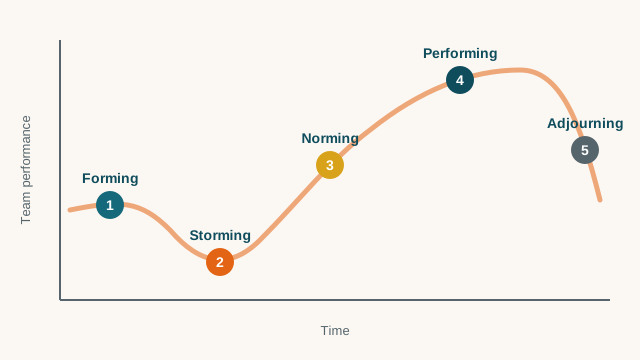
Activities by team stage
Forming, storming, norming, performing, adjourning – which activity helps at which stage.
To the 5 stages →Is the shared experience more important to you than deliberately working on collaboration? Then you will find inspiration in our team event ideas for summer parties, kick-offs or Christmas parties, in our team outing ideas for a day away from the office – and if it definitely shouldn't be the usual classic, in our unusual team building ideas.
Activity finder: 40 team building activities at a glance
Filter by location, duration, goal and group size. Each activity is briefly described – you will find more details on the relevant topic pages.
Spaghetti Bridge Building
Teams build a load-bearing bridge from spaghetti and tape – planning, roles and communication become visible immediately.
Chain Reaction
Each team builds a module, and all modules are linked into one big chain reaction – interface work at its purest.
LEGO® Serious Play
Visions, values and roles are modelled with LEGO bricks – quieter team members get their say too.
Escape Room
Solve puzzles against the clock – live or online. Encourages information sharing and division of labour.
Cooking Together
Plan, cook and enjoy a menu as a team – natural role allocation and plenty to talk about.
Baking Competition
Teams design and bake a cake to a brief – with a budget, a jury and a presentation.
AI Team Challenge
Teams solve tasks with the help of AI tools – combining professional development with teamwork.
Code-Cracking Challenge
Encrypted clues that can only be deciphered together – ideal for large groups too.
Build the City of the Future
Teams develop parts of a future city that have to fit together at the end – coordination across team boundaries.
Marshmallow Challenge
The tallest free-standing tower made from 20 spaghetti sticks, tape, string and one marshmallow – in 18 minutes.
Raft Building
Build a seaworthy raft from barrels, planks and ropes and test it together – the classic.
GPS Rally / Geocaching
Find checkpoints with a smartphone or GPS device, solve tasks and collect points.
High Ropes Course
Belaying, encouraging, pushing boundaries – builds trust but should always remain voluntary.
City Rally
Teams explore a city with puzzles, photo tasks and local stories.
Soapbox Cup
Design, decorate and race soapbox carts against each other.
Stand-up Paddling / Canoeing
Out on the water together – canoe trips require genuine teamwork in the boat.
Team Hike with Tasks
A hike with reflection stops: conversation prompts in changing pairs.
Company Olympics
Fun disciplines such as team skis, sack races or water relays – for large groups.
Wind Park Challenge
Teams build working wind turbines and optimise the energy yield together.
Archery
Concentration, peer coaching and a joint tournament.
Blindfold Course
A blindfolded person is guided through a course using only the team's words.
Two Truths and a Lie
Each person makes three statements about themselves – the others guess which one is false.
Lifeline / Personal Map
Each person draws key milestones of their life – quickly creates closeness and understanding.
Back-to-Back Drawing
One person describes a picture, the other draws it – shows how quickly messages get distorted.
Human Knot
Join hands and untangle the knot together without letting go.
Egg Drop
Use minimal materials to build a structure that protects a raw egg in a fall.
PowerPoint Karaoke
Give an unseen presentation on the spot – trains improvisation and guarantees laughs.
Speed Networking
Short rounds of conversation with changing partners and set questions.
Appreciation Round
Each person receives specific, positive feedback from the others – simple and effective.
Team Canvas Workshop
Capture goals, values, roles and rules on a shared canvas.
Personality Workshop (e.g. DISC)
Learn to understand and appreciate different working styles.
Hackathon / Idea Sprint
Solve a real company challenge together in a short time.
Drumming or Music Workshop
Find a rhythm together – non-verbal coordination in its purest form.
Murder Mystery Dinner
Solve a case together over dinner – roles, clues and powers of deduction.
Tournament Fun (Table Football, Table Tennis)
Tournaments with mixed teams – relaxed, connecting and low effort.
Virtual Coffee Break
Randomly assembled pairs or groups of three for 15 minutes of small talk.
Online Team Quiz
A quiz with questions about the company, the team and general knowledge in mixed teams.
Show & Tell / Home Office Tour
Each person shows an object from their surroundings and tells the story behind it.
Digital Team Challenge
Facilitated online tasks in which distributed teams complete a mission together.
Weather Report Retrospective
Each person describes their mood as a weather forecast – an entry point into an honest team retro.
Many of these formats – such as bridge building, chain reactions, code cracking, AI challenges or wind park building – are offered by BITOU as ready-designed, facilitated events. You can find an overview of the team building activities by BITOU here.
Which team building activity suits which goal?
The most common reason team events have no effect: the activity doesn't match the actual concern. This matrix helps you choose.
| Your goal | Well-suited activities | Less suitable |
|---|---|---|
| Getting to know a new team | Lifeline, speed networking, cooking event, city rally | Conflict workshop, high ropes course |
| Improving communication | Bridge building, back-to-back drawing, chain reaction, blindfold course | pure fun events without reflection |
| Strengthening trust | Appreciation round, raft building, personality workshop | competitions with winners and losers |
| Improving interfaces | Chain reaction, city of the future, code-cracking challenge | activities within a single department only |
| Creativity & innovation | LEGO Serious Play, hackathon, AI challenge, baking competition | highly structured sports events |
| Resolving conflicts | facilitated team building workshop, team coaching | events that paper over conflicts |
| Saying thank you & celebrating | Cooking event, murder mystery dinner, company Olympics | work-intensive workshops |
Ask your team beforehand in a short anonymous survey: "What's going well? What should we improve?" The answers often show whether you need a getting-to-know-you event, a cooperative task or a facilitated workshop.
Team building activities by team stage
According to the model developed by psychologist Bruce Tuckman, teams develop in five stages. If you know where your team currently stands, you can choose far more accurately:
- Forming (orientation): get-to-know-you games, lifeline, shared meals.
- Storming (friction): facilitated workshop, communication exercises, clear ground rules.
- Norming (establishing rules): team canvas, cooperative tasks such as bridge building.
- Performing (high performance): demanding challenges, hackathons, appreciation events.
- Adjourning (closure): retrospective, farewell party, celebrating successes.
You will find detailed descriptions, warning signs and suitable exercises for each stage in the article the 5 stages of team development.
Planning team building activities in 7 steps
- Define the goalWhat should be different after the activity? Formulate a concrete, observable goal.
- Involve the teamA short survey on wishes, constraints (mobility, diet, family) and dates.
- Choose the formatSelect location, duration and method to suit the goal – see the matrix above.
- Clarify budget & frameworkCost per person, working time, travel, catering and any tax aspects.
- Decide on facilitationInternal or external? With conflicts or large groups, neutral facilitation is worth its weight in gold.
- Run it & reflectAfter each activity: What happened? What helped? What do we take away?
- Secure the transferRecord 2–3 concrete agreements and review them after 4–6 weeks.
You will find a detailed checklist, sample schedules and notes on tax under team building planning: costs, schedule & checklist.
How much do team building activities cost?
Costs depend heavily on format, group size, duration and location. As a rough guide (as of 2026, excluding VAT):
| Format | Cost per person | Notes |
|---|---|---|
| Team building games in a meeting | €0–5 | materials and working time only |
| Self-organised team day | €20–80 | venue, catering, materials |
| Virtual team event (facilitated) | €30–90 | often with a minimum fee |
| Facilitated indoor/outdoor team event | €50–150 | incl. concept, materials, facilitation |
| Team building workshop with a trainer | €80–250 | depending on preparation and duration |
| Multi-day team trip / retreat | €300–1,000+ | incl. accommodation and programme |
With professional providers, the price per person usually falls significantly as group size increases. So always ask for an individual quote.
7 common mistakes with team building activities
- No clear goal: "Let's do something together" rarely leads to lasting change.
- Compulsion instead of choice: tests of courage such as high ropes or fire walking exclude people.
- Competition only: winner-loser formats can deepen divides instead of bridging them.
- No reflection: without a debrief, it remains just a nice day out.
- Poor timing: a team event in the most stressful project phase or on a Friday evening.
- Glossing over conflicts: a fun event won't resolve a real conflict – that needs facilitation.
- One-off action: team building works best as a regular routine, not as an annual highlight.
Organise it yourself or book a professional provider?
Managers can easily lead short team building games and smaller team days themselves. An external provider is particularly worthwhile if
- the group is larger than about 20 people,
- you want to take part yourself rather than facilitate,
- there are tensions in the team that require a neutral person,
- materials, logistics and schedule need to be professionally prepared,
- you want to combine the experience with a learning effect (debriefing).
Experienced providers such as BITOU have been working with groups of 10 to over 3,000 people for more than 20 years – indoors, outdoors and virtually. Cooperative formats such as spaghetti bridge building, the Chain Reaction XXL or the LEGO® Creative Game are in particularly high demand.
Frequently asked questions about team building activities
What can you do as team building activities?
Team building activities range from short get-to-know-you games in meetings and facilitated workshops (e.g. LEGO Serious Play, Team Canvas) to cooperative tasks such as bridge building or chain reactions and outdoor formats like raft building, geocaching or cooking events. For distributed teams, virtual escape rooms, online quizzes and digital cooperation games work well. What matters is that the activity fits the goal and ends with a reflection. Try our activity finder.
What are the 10 golden rules of good teamwork?
1. Clarify a shared goal, 2. define roles and responsibilities, 3. communicate openly and respectfully, 4. listen to one another, 5. build trust and keep commitments, 6. give and accept feedback, 7. resolve conflicts early and objectively, 8. share knowledge, 9. celebrate successes together, 10. reflect on and improve collaboration regularly. Explained in detail in rules for good teamwork.
What are the 3 pillars of teamwork?
The three pillars of teamwork are trust (psychological safety), communication (open, regular exchange) and a shared goal (a common understanding of what the team is working towards). Good team building activities deliberately strengthen at least one of these pillars.
What are the 5 stages of team building?
According to Bruce Tuckman's model, a team goes through five stages: forming (orientation), storming (conflict and power struggles), norming (rules and cohesion), performing (high performance) and adjourning (disbanding or closure). Each stage calls for different team building activities. Find out more under the 5 stages of team development.
How much does a team building activity cost?
Self-organised activities often cost nothing more than materials and time. Professionally facilitated team events typically range from around €50 to €250 per person, depending on format, duration and group size, plus venue, catering and travel. Multi-day team development programmes cost correspondingly more. Details in our cost overview.
How often should you do team building?
A combination has proven effective: short team building impulses weekly or monthly as part of everyday work, plus one or two larger team events or workshops a year – and additionally whenever the team changes significantly, for example with new members, restructuring or conflicts.

Written by Joachim Grittmann, BITOU GmbH. For more than 20 years, BITOU has been designing and facilitating team building activities, team events and team development for groups of 10 to over 3,000 people – experience from this practice feeds into the Teambuilding-Kompass.