 Teambuilding-Kompass
Key points at a glance
- A team building workshop tackles a specific aspect of collaboration – such as roles, values, communication or conflicts – and ends with binding agreements.
- A half-day is enough for one clearly defined topic; a full day suits several topics or resolving a conflict.
- The typical team workshop agenda: arrival → energiser → taking stock → deep dive → agreements → close.
- The facilitator stays neutral, steers the process and holds back on content. Where there are conflicts, an external person is usually the better choice.
- Without a follow-up after 4–8 weeks, even the best workshop results fizzle out.
When to choose a workshop instead of a team event
Not every challenge in a team can be solved with a shared experience. A team event strengthens team spirit, creates shared stories and serves as a thank-you. A workshop, on the other hand, creates space to talk about the collaboration itself – and to change things. The distinction matters, because a fun event in a team with unclear responsibilities can even increase frustration: everyone notices that the real problem was never addressed.
A team building workshop is the right choice if …
- responsibilities are unclear and tasks are done twice or not at all,
- the team has been newly formed and lacks shared goals and rules,
- tensions can be felt, but nobody addresses them openly,
- a restructuring, merger or change of leadership is coming up or has just happened,
- a project has gone wrong and the team wants to learn from it,
- the team works well but wants to reach the next level.
A combination is often the most effective: an experiential exercise in the morning makes patterns visible, and the workshop part in the afternoon works through them. Our overview of team building activities shows which formats work well as an opener; you will find short warm-ups under team building games.
| Criterion | Team event | Team building workshop |
|---|---|---|
| Focus | Experience, fun, appreciation | A specific aspect of collaboration |
| Outcome | Good mood, shared memories | Agreements, roles, rules |
| Reflection | short or optional | a central element |
| Facilitation | Game leader | Process facilitation, coaching skills if needed |
| Preparation | mainly logistics | Clarifying the brief, interviews, design |
| Follow-up | Photos, thank-you | Minutes, follow-up session |
Preparation: half the battle
The quality of a workshop is largely decided before the actual session. These steps have proven themselves:
- Clarify the briefWhat should be different after the workshop? Who initiated it, and why now? Write down one to three goals – as observable as possible (“Every task in the project has one clearly responsible person”).
- Gather voicesShort one-to-one conversations or an anonymous online survey show how the team itself sees the situation. This often differs considerably from the manager's view.
- Define the manager's roleAre they a participant, the client or both? How do they deal with criticism? This should be discussed with the facilitator in advance.
- Draft the designChoose methods that fit the goal, plan in time buffers and prepare alternatives in case a topic needs more space.
- Create the settingA room with daylight, movable chairs, pinboards and some distance from everyday office life. Smartphones and emails wait for the breaks.
- Write the invitationMake the goal, agenda and ground rules transparent. People who know what to expect arrive with a more open mind.
The best way to plan time, budget and venue is with our checklist in team building planning and costs.
Team building workshop agenda: sample plans for a half-day and a full day
The following plans are templates that you adapt to your goal and team. What matters is the dramaturgy: first arrive and build trust, then open up and analyse, and finally condense and agree.
Half-day team building workshop (4 hours)
| Time | Module | Content and method |
|---|---|---|
| 9:00–9:30 | Arrival and check-in | Welcome, goals and agenda, ground rules, check-in round on the mood |
| 9:30–10:15 | Energiser | Cooperation exercise (e.g. a building task), short review: what did we notice? |
| 10:15–11:00 | Taking stock | Team clock or retrospective: what is going well, where are things stuck? |
| 11:00–11:15 | Break | – |
| 11:15–12:15 | Deep dive | Work on the core topic, e.g. role clarification, values workshop or World Café |
| 12:15–12:45 | Agreements | 2–3 concrete agreements with owners and a review date |
| 12:45–13:00 | Close | Quick-fire feedback, outlook on the follow-up |
Full-day team building workshop (7–8 hours)
| Time | Module | Content and method |
|---|---|---|
| 9:00–9:45 | Arrival | Welcome, goals, gathering expectations, personal opener (e.g. a short lifeline exercise) |
| 9:45–11:00 | Experiential part | Larger cooperation task in small groups with a shared end result |
| 11:00–11:15 | Break | – |
| 11:15–12:30 | Debriefing and analysis | Review of the exercise, transfer to everyday work, team clock to take stock |
| 12:30–13:30 | Lunch break | Eating together, deliberately without a programme |
| 13:30–14:15 | Energiser and strengths | Short activation, then strengths profile: who contributes what? |
| 14:15–15:30 | Core topic | Role clarification with RACI, conflict facilitation or values workshop |
| 15:30–15:45 | Break | – |
| 15:45–16:30 | Team agreement | Formulate rules and agreements and adopt them together |
| 16:30–17:00 | Close | Appreciation round, feedback on the day, set the follow-up date |
Don't schedule a demanding discussion straight after lunch; plan an activity with movement instead. Difficult topics belong in the late morning or in the early afternoon after the energiser.
12 team building workshop methods for team development
The choice of method always follows the goal – not the other way round. The following team development workshop methods cover the most common needs.
1. Team canvas
A large-format template on which the team records its purpose, goals, values, roles, strengths, personal needs and rules. Ideal for new teams or as a fresh start after changes. The result is a one-page picture of who the team is and how it wants to work.
2. LEGO® Serious Play®
Participants build models in response to questions such as “How do I see my role?” or “How should our team be working in a year's time?” and then explain them. Building gives quieter people an equal voice and makes abstract topics tangible. The method requires a trained facilitator. If you would rather use the playful building approach as an experience with a focus on cooperation, the LEGO® Creative Game offers a variant: teams build individual levels of a tower with marble runs that have to fit together seamlessly at the end – a good start for discussing silo thinking in the workshop afterwards.
3. Team clock
The team clock shows the stages of team development as a clock face. Each person marks where they currently see the team. The differences between the assessments are often more revealing than the average. You will find the background in our article on Tuckman's stages of team development.
4. Values workshop
The team collects the values that matter to it in its collaboration, narrows them down to three to five and translates each value into concrete behaviour: “For us, appreciation means we reply within one working day.” Without this translation, values remain posters on the wall.
5. Strengths profile
Each person names their own strengths and receives feedback on the strengths others see in them. Team role models can also help people understand differences as a resource. The result shows where the team is well positioned and where skills are missing.
6. Retrospective
Familiar from agile working: the team looks back on a period in a structured way – for example with the questions “What went well? What didn't go well? What shall we try next?”. Retrospectives also work well as a regular ritual after the workshop.
7. Conflict facilitation
In the case of open conflicts, the facilitator guides those involved through a structured clarification: describing perspectives without interruption, uncovering the interests behind positions, developing options and making agreements. This method belongs in experienced hands.
8. Fishbowl
A small inner circle discusses while the outer circle listens. An empty chair in the inner circle allows anyone to join in at any time. Fishbowl is suitable for larger groups and for topics where careful listening matters more than quick solutions.
9. World Café
Different questions are discussed at several tables, and participants move on after each round. One host per table summarises what has been said so far. This quickly produces a broad picture – ideal for gathering ideas and for groups of around twelve people or more.
10. Feedback rounds
Structured feedback, for example following the pattern “What I appreciate about you – what I would like from you”, strengthens trust when it is well guided. Clear rules are important: specific, observable, appreciative and always phrased as an “I” statement.
11. Role clarification (e.g. RACI)
For recurring tasks, the team defines who is Responsible, who makes the final decision (Accountable), who is involved in an advisory capacity (Consulted) and who needs to be kept Informed. The matrix makes gaps and overlapping responsibilities visible immediately.
12. Team agreement
To finish, the team formulates binding rules: availability, meeting culture, how to deal with mistakes, decision-making paths. A good team agreement is short, concrete and reviewed regularly. Our article on rules for good teamwork offers inspiration.
| Goal of the workshop | Suitable methods |
|---|---|
| Setting up a new team | Team canvas, strengths profile, team agreement |
| Clarifying responsibilities | Role clarification (RACI), team canvas |
| Sharpening culture and values | Values workshop, LEGO Serious Play, World Café |
| Working through tensions | Conflict facilitation, fishbowl, feedback rounds |
| Learning from experience | Retrospective, team clock |
Facilitating a team building workshop: role and attitude
The facilitator is responsible for the process, not the content. They make sure that everyone is heard, that time is kept and that there are usable results at the end. On content, they hold back – the team is the expert on its own collaboration.
Good facilitators are characterised by:
- Impartiality: they take no sides – not even the manager's.
- Structure and flexibility: they have a plan, but depart from it when an important topic needs space.
- Confidence in dealing with emotions: tears, anger or silence are part of the process and are not glossed over.
- Good questions: open, circular and solution-focused questions that make the team think.
- Visualisation: results are recorded visibly as the session goes on.
Internal or external facilitation?
Internal facilitation – for example from HR development or another department – is sufficient for topics such as clarifying goals, retrospectives or team agreements. You should bring in external support when conflicts are involved, when the manager could be part of the problem or when the team has already had bad experiences with workshops. For longer-lasting tensions, accompanying team coaching over several weeks is often more effective than a single session – BITOU, for example, combines a kick-off workshop with regular reflection sessions.
Managers should deliberately act as a team member in the workshop: listen first, name their own mistakes and not defend themselves against criticism. A conversation with the facilitator beforehand helps to clarify their own role.
Debriefing questions: from experience to insight
Every exercise needs a review. A three-step approach has proven itself: What happened? What does it mean? What do we do with it? These questions help:
What happened?
- How did you approach the task?
- Who took on which role – consciously or unconsciously?
- At what moment did things go particularly well, and when did they tip over?
What does it mean?
- What does this remind you of in our everyday work?
- What information was missing, and why?
- What helped us as a team, and what held us back?
What do we do with it?
- What do we want to do differently from Monday?
- How would we notice that it's working?
- Who will take care of it, and by when?
Many experiential formats are designed for this kind of debriefing from the outset. The Turn Around format, for example, playfully confronts teams with shifting priorities and unexpected changes and ends with a joint reflection – a fitting opener if the workshop deals with change processes.
Transfer: making the workshop count
The biggest weakness of many workshops lies not in the workshop itself but in the weeks that follow. In everyday work, old habits quickly catch up with the team. This is how you secure the transfer:
- A few concrete agreementsBetter three agreements that are put into practice than twelve that disappear into the minutes.
- Name the ownersEvery agreement has one person who looks after it and follows up.
- Make it visibleShare results as photo minutes, pin the team agreement in the team room or digital channel.
- Build it into routinesA short item in the weekly team meeting: “How are we doing with our agreements?”
- Schedule the follow-upAfter four to eight weeks, a 60- to 90-minute session: what is working, what do we need to adjust?
For distributed teams, the follow-up can easily be held online – you will find tips in our article on virtual team building.
Typical mistakes in a team building workshop
- Hidden agenda: the workshop is announced as a “team day” but is actually about resolving a conflict. This destroys trust.
- Overloaded programme: one method after another, with no time for what really matters to people.
- Results without commitment: nice posters, but nobody is responsible.
- The manager dominates: if the boss anticipates the results, the team falls silent.
- No follow-up: after two weeks, everything is back to how it was – and the next workshop is met with scepticism.
For workshops that are meant to combine experience and learning, it is worth looking at facilitated team building activities that already include a structured reflection. If you would rather move the experiential part outdoors, you will find ideas under outdoor team building.
Frequently asked questions about team building workshops
How does a team building workshop work?
A team building workshop starts with arrival, clarifying goals and a check-in. This is followed by an energising exercise, then the team takes stock of where it stands and goes deeper into the core topic, such as roles, values or communication. At the end come concrete agreements and a date on which their implementation is reviewed.
How long does a team workshop take?
For a single, clearly defined topic, a half-day of around four hours is enough. If several topics are to be covered or conflicts resolved, a full day makes sense. For in-depth team development, several sessions spread over a few weeks have proven effective.
Which methods are suitable for a team building workshop?
Proven methods include the team canvas, LEGO Serious Play, the team clock, a values workshop, a strengths profile, retrospectives, conflict facilitation, fishbowl, World Café, structured feedback rounds, role clarification with RACI and a written team agreement. The choice depends on the goal of the workshop.
Do you need an external facilitator for a team workshop?
Not always. For topics such as clarifying goals or retrospectives, an experienced internal person can facilitate. In the case of conflicts, hierarchy issues or when the manager is part of the topic, neutral external facilitation is recommended so that everyone can speak openly.
What is the difference between a team event and a team building workshop?
A team event focuses on a shared experience and fun, and the reflection is usually short. A team building workshop works specifically on one aspect of collaboration, such as roles, values or conflicts, and ends with binding agreements for everyday work.
You might also be interested in
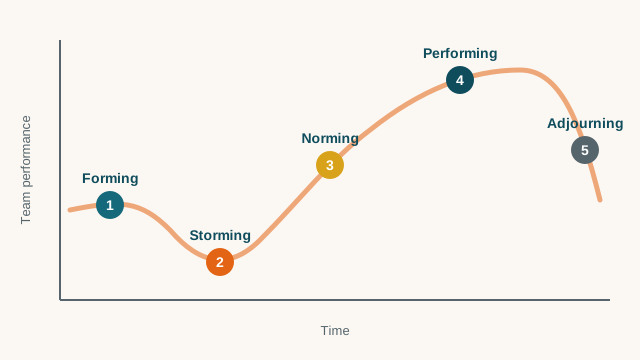
Stages of team development
Forming to adjourning: which workshop helps at which stage.
See the 5 stages →
Indoor team building
Cooperation tasks that work well as the experiential part of a workshop.
View indoor ideas →
Planning & costs
Budget, venue and checklist for your next team workshop.
Start planning →
Written by Joachim Grittmann, BITOU GmbH. For more than 20 years, BITOU has been designing and facilitating team building activities, team events and team development for groups of 10 to more than 3,000 people – experience from this practice feeds into the Teambuilding-Kompass.