 Teambuilding-Kompass
Key points at a glance
- Team building games are short, guided exercises of 5 to 30 minutes that encourage getting to know each other, communication, trust or problem solving.
- Around half of the games on this page are team building games without materials – ready to use straight away in the office or a meeting.
- The effect comes from the reflection: a good question after the game links the experience with everyday work.
- Voluntary participation and a respectful setting are a must – especially with adults who are sceptical of "silly games".
- For larger groups or more depth, facilitated team building activities by BITOU are a good option.
When team building games make sense
Team building games for adults get a bad reputation when they come across as fillers. Used properly, however, they are one of the most efficient tools for teamwork: they take little time, need no budget and still reveal how a team communicates, makes decisions and treats each other.
Typical moments to use them are the start of a workshop, the weekly team meeting, onboarding new colleagues, an energy slump after lunch or the end of a project. For longer formats such as construction tasks or team days, read our guides to indoor team building and outdoor team building. You will find the complete overview of all team building activities on our home page.
All 25 team building games at a glance
| Game | Category | Duration | Materials |
|---|---|---|---|
| One-word check-in | Icebreaker | 5 min | none |
| Two Truths and a Lie | Icebreaker | 15 min | none |
| Common ground hunt | Icebreaker | 10 min | paper, pen |
| Lining up by criteria | Icebreaker | 10 min | none |
| Three pictures of me | Icebreaker | 20 min | smartphone |
| Back-to-back drawing | Communication | 15 min | paper, pen |
| Paper folding without questions | Communication | 10 min | paper |
| One-word story | Communication | 10 min | none |
| Listening in threes | Communication | 20 min | none |
| Blueprint dictation | Communication | 20 min | building blocks |
| Guiding blind | Trust | 15 min | blindfolds |
| Appreciation round | Trust | 15 min | none |
| Learning stories round | Trust | 20 min | none |
| What I need from you | Trust | 25 min | cards |
| Helium stick | Trust | 10 min | light stick |
| Marshmallow challenge | Problem solving | 30 min | spaghetti, tape, marshmallow |
| Human knot | Problem solving | 10 min | none |
| Flip the tarp | Problem solving | 15 min | tarpaulin/blanket |
| Shipwreck ranking | Problem solving | 30 min | list |
| Blind rope square | Problem solving | 20 min | rope, blindfolds |
| Count to 20 | Energiser | 5 min | none |
| Zip Zap Boing | Energiser | 5 min | none |
| Yes, and … | Energiser | 10 min | none |
| Group juggling | Energiser | 10 min | 3–5 balls |
| Rock-paper-scissors fan club | Energiser | 5 min | none |
Getting to know each other and icebreakers
Icebreakers lower the threshold at the start of a meeting. Good get-to-know-you games let each person decide for themselves how much they reveal.
1. One-word check-in
- Ask a question such as: "How are you arriving here today?"
- Each person answers in turn with exactly one word.
- No comments, no follow-up questions – just listen.
Reflection question: What does it help us to know how the others are doing today?
2. Two Truths and a Lie
- Everyone thinks of three statements about themselves, one of which is made up.
- The statements are presented in turn.
- The group guesses the lie, then the answer is revealed.
Reflection question: Which assumption about a colleague has just turned out to be wrong?
3. Common ground hunt
- Form groups of three or four.
- Each group has five minutes to find as many unusual things in common as possible (not "we work here").
- The groups present their most surprising common ground.
Reflection question: What connects us that we would never have noticed in everyday work?
4. Lining up by criteria
- The group lines up in a row, sorted by one criterion: commute, years with the company, coffee consumption.
- After each line-up, ask two or three people about their position.
- Change the criterion three or four times.
Reflection question: How diverse are the experiences in our team – and how do we use them?
5. Three pictures of me
- Each person chooses three photos from their phone that say something about them.
- In small groups, the pictures are shown and briefly explained.
- The others each ask one curious question.
Reflection question: What have you learned about someone that makes working together easier?
Communication games
These team building games make it tangible how easily messages get lost – and what precise communication is all about. An extensive, facilitated communication training with spatial tasks is, for example, Race for Space, which is particularly suitable for teams spread across several locations.
6. Back-to-back drawing
- Two people sit back to back.
- Person A describes a simple picture made of shapes; person B draws it without asking questions.
- Compare, then swap roles – this time with questions allowed.
Reflection question: What changed when questions were allowed?
7. Paper folding without questions
- Everyone closes their eyes and follows your instructions: "Fold the sheet in half. Tear off the top right corner …"
- Questions are not allowed.
- Everyone opens their eyes and compares their sheets.
Reflection question: Why do the results look so different despite identical instructions?
8. One-word story
- The group stands in a circle.
- In turn, each person adds exactly one word to a shared story.
- After a few rounds, one person sums up the story.
Reflection question: How well were we able to let go of our own plans and respond to the others?
9. Listening in threes
- Roles: storyteller, listener, observer.
- The storyteller talks for three minutes about a work topic; the listener then sums it up in their own words.
- The observer gives feedback, then the roles rotate.
Reflection question: How could you tell that you had really been understood?
10. Blueprint dictation
- A finished model stands behind a screen.
- A "messenger" may look at it and describe it to the building team but not build it themselves.
- After ten minutes, compare the results.
Reflection question: Which information did the building team miss most?
Trust games
Trust exercises need a safe setting. Make sure nobody is pressured – and stick to exercises without falls or physical risk.
11. Guiding blind
- One person closes their eyes; the other guides them through the room using words only.
- Swap roles after five minutes.
- Short exchange in the pairs.
Reflection question: What did you need from your partner in order to feel safe?
12. Appreciation round
- One person after another takes centre stage.
- Two or three colleagues name something specific they appreciate about them.
- The person simply says thank you – without playing it down.
Reflection question: How often do we tell each other in everyday work what we appreciate about one another?
13. Learning stories round
- As the manager, start with a professional mistake of your own and what you learned from it.
- Anyone who wants to tells a story of their own.
- The group collects the lessons learned.
Reflection question: What would need to happen for mistakes to be raised earlier in our team?
14. What I need from you
- Each person writes for two or three colleagues: "What I need from you to be able to work well …"
- The cards are handed over and discussed in pairs.
- Each person names one agreement they want to put into practice.
Reflection question: Which expectation were you not aware of before?
15. Helium stick
- The group rests the stick on outstretched index fingers.
- Goal: lower it to the ground together. All fingers must stay in contact at all times.
- The stick usually rises at first – until the group finds a strategy.
Reflection question: What helped when everyone wanted to do the "right" thing at the same time?
Problem-solving games
Cooperative tasks show how a team plans, decides and deals with setbacks. If you want to experience these dynamics playfully and competitively, Team 11, a football strategy game with a transfer market and league tournament, is a facilitated format for larger groups.
16. Marshmallow challenge
- Each team receives the same materials.
- Task: build the tallest free-standing tower with the marshmallow on top – in 18 minutes.
- Measure and compare the construction methods.
Reflection question: When did we test for the first time – and what would testing earlier have achieved?
17. Human knot
- Everyone stands close together in a circle, closes their eyes and grabs two other people's hands.
- Eyes open: the group untangles the knot without letting go.
- The goal is one big circle.
Reflection question: Who coordinated – and how was that decided?
18. Flip the tarp
- Everyone stands on a tarpaulin that is just big enough.
- The tarpaulin must be turned over completely without anyone touching the ground.
- If anyone touches the ground, the group starts again.
Reflection question: How did we deal with ideas that sounded crazy at first?
19. Shipwreck ranking
- Scenario: the team is stranded on a desert island.
- Each person first ranks twelve items by usefulness on their own.
- The group then agrees on a joint ranking by consensus.
- Comparison: how do the individual and group results differ?
Reflection question: Whose knowledge was given too little weight in the discussion?
20. Blind rope square
- Everyone wears a blindfold or closes their eyes and holds on to a rope.
- Task: form the rope into a perfect square.
- When the group is finished, everyone opens their eyes.
Reflection question: How did we organise ourselves without sight – and who had the overview?
Energisers
Energisers bring movement and laughter into long sessions. They usually last only a few minutes and don't need an extensive reflection – a short question is enough.
21. Count to 20
- The group counts to 20 together; each number is said by one person.
- There is no fixed order and no prior agreement.
- If two people speak at the same time, the group starts again at one.
Reflection question: What helped us pay attention to each other?
22. Zip Zap Boing
- In a circle, an impulse is passed to the neighbour with "Zip".
- "Zap" sends it across the circle, "Boing" bounces it back.
- The pace increases; mistakes are celebrated with applause.
Reflection question: How does it feel when mistakes are applauded instead of criticised?
23. Yes, and …
- Pairs plan a fictitious team party.
- Round 1: every sentence starts with "Yes, but …".
- Round 2: every sentence starts with "Yes, and …".
Reflection question: Which round produced more ideas – and what do our meetings sound like?
24. Group juggling
- A ball is thrown around the circle so that each person has it once – this sets the fixed order.
- Gradually, more balls are added.
- Goal: keep as many balls in circulation as possible without dropping any.
Reflection question: What happens to our system when more tasks run at the same time?
25. Rock-paper-scissors fan club
- Everyone plays rock-paper-scissors in pairs.
- The loser becomes the winner's noisy fan and follows them to the next duel.
- In the end, two huge fan clubs cheer on the final.
Reflection question: How quickly can support for others turn into shared energy?
BITOU collects further suggestions – from games for online meetings to seasonal team activities – in its 27 team building ideas for companies. We have put together our own suggestions specifically for remote teams in the article virtual team building.
How to introduce team building games properly
Whether a game succeeds is decided in the first minute. Adults want to know why they are doing something – and that they won't embarrass themselves.
- State the purpose"In the next ten minutes, we want to try out how we coordinate without talking it through."
- Explain the rules brieflyNo more than three sentences, ideally with a short demonstration.
- Emphasise that it's voluntaryAnyone who doesn't want to play can observe – and thus has a valuable role.
- Join in yourselfManagers who take part lower the threshold enormously.
- Limit the timeA clear end provides security and keeps the energy up.
Don't call it a "game" if your team is sceptical. "A short experiment" or "an exercise" often sounds more serious – the experience remains the same.
Debriefing: turning the game into a learning moment
Without a debrief, a game remains entertainment. A proven pattern is the three-step "What? – So what? – Now what?":
- What happened? Collect observations: Who did what? When did it go well, when did it stall?
- What does it mean? Recognise patterns: Is this typical of us? Where do we experience this in everyday work?
- What do we do now? Derive a concrete agreement, such as "We sum up assignments in one sentence at the end of every meeting."
Record the results in writing and pick them up again in one of the next meetings. If your team wants to anchor the agreements permanently, shared rules for good teamwork help. For deeper topics such as roles or conflicts, a facilitated team building workshop is a good fit. The article on the stages of team development shows which games suit which team situation: in the forming stage, icebreakers are called for; in the storming stage, communication exercises are more appropriate.
Frequently asked questions about team building games
Which team building games need no materials?
Games that work without materials include Two Truths and a Lie, the common ground hunt, lining up by criteria, Count to 20, Zip Zap Boing, "Yes, and" stories, the human knot and appreciation rounds. All you need is a little space and clear instructions.
What are good quick team building games for the office?
For the office, games that work in 5 to 15 minutes and require no rearranging are ideal: a one-word check-in, Two Truths and a Lie, Count to 20, One-Word Story or a short appreciation round. They work well at the beginning or end of a meeting.
How do you lead a team building game properly?
First briefly explain the purpose, then the rules in no more than three sentences, show the process with an example and emphasise that nobody has to reveal anything personal. After the game, follow up with a short reflection using an open question so that the link to collaboration becomes clear.
Why are team building games for adults worthwhile?
Team building games create shared experiences in a short time, lighten the mood and reveal communication patterns that often go unnoticed in everyday work. Combined with a reflection, they help build trust and consciously improve collaboration.
How many team building games should you play in a row?
In a meeting, a single short game is usually enough. In a workshop, two to three games spread over the day have proven effective: an icebreaker at the start, an energiser after the lunch break and a cooperation or trust exercise with a thorough reflection.
Read more
Indoor Team Building
15 ideas for longer team events in the office, conference hotel or event venue.
Indoor ideas →
Team Building Workshop
How to embed games in a facilitated workshop with a clear goal.
To the workshop →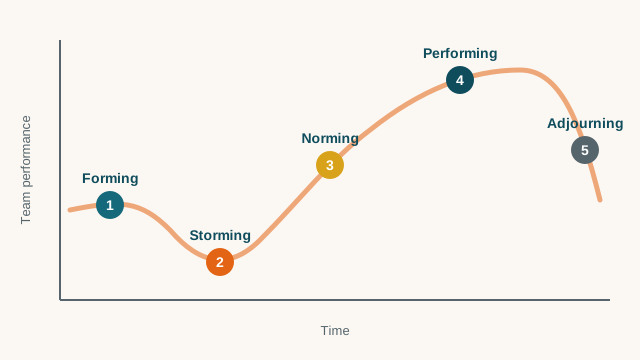
Stages of Team Development
Which exercises help in forming, storming, norming and performing.
To the 5 stages →
Written by Joachim Grittmann, BITOU GmbH. For more than 20 years, BITOU has been designing and facilitating team building activities, team events and team development for groups of 10 to over 3,000 people – experience from this practice feeds into the Teambuilding-Kompass.