 Teambuilding-Kompass
Key points at a glance
- For a one-day team event, allow around 8 weeks' lead time – more in peak season.
- Team building costs range from €0–5 per person (games in a meeting) to €300–1,000+ (multi-day retreat), all net.
- In Germany, a company event benefits from a tax allowance of €110 per person for up to two events a year – rules differ in other countries, so check the details with your tax adviser.
- Whether team building counts as working time depends mainly on whether attendance is required.
- Impact comes from a clear goal, a debrief and follow-up – measure it with a short survey before and after.
Before you plan: three fundamental questions
Many team events fail not because of the organisation but because the starting point is unclear. So before you request the first quote, answer three questions – ideally in writing, so that everyone involved is talking about the same thing:
- Why? Is it about getting to know each other, better coordination between departments, a thank-you after a tough year or unresolved tension? The goal determines the format – not the other way round.
- Who? A team of eight needs something different from a division with 120 employees. Also clarify whether remote colleagues, apprentices or managers from other levels will take part.
- What may it cost – in money and time? Half a day during working hours is more realistic for many teams than a whole Saturday.
Our main guide to team building activities gives an overview of possible formats – from short exercises to large events. Once you have answered the fundamental questions, the actual planning can begin.
Team building planning: checklist from 8 weeks out to follow-up
The following checklist is designed for a full-day or half-day team event for 10 to 60 people. For smaller formats you can combine steps; for multi-day retreats you should double the lead time.
8 weeks before: define the goal and framework
- Formulate the goal of the activity in one or two sentences ("After the team day …")
- Agree the budget with management or the cost centre
- Define the group of participants and estimate the number of people
- Collect two or three possible dates, taking holidays and project peaks into account
- Inform the works council (if there is one) and the managers concerned at an early stage
- Name the person responsible for the organisation
6 weeks before: involve the team and choose the format
- Short survey: wishes, constraints (mobility, diet, family commitments), preferred date
- Choose the format: indoor, outdoor, virtual or as a workshop
- Decide: facilitate it yourself or hire an external provider
- Obtain two or three comparable quotes
- Check venue options (accessibility, size, an alternative room in case of rain)
4 weeks before: book and invite
- Confirm the booking with the provider and venue, and document the cancellation terms
- Send the invitation: goal, date, time, place, rough schedule, what to wear
- State clearly whether it counts as working time and whether attendance is voluntary
- Organise travel (car sharing, coach, train tickets)
- Book catering and ask about dietary requirements
2 weeks before: finalise the details
- Agree the running order with the facilitator or provider, including breaks and the debrief
- Finalise the participant list, taking cancellations and late registrations into account
- Check accessibility and plan alternatives for people with impairments
- Confirm the bad-weather option for outdoor programmes
- Clarify the manager's role: take part, observe or just open the event?
1 week before: baseline measurement and final information
- Run a short pulse survey (three to five questions) as a baseline
- Send a final information email: meeting point, times, contact person, emergency number
- Confirm materials and equipment (projector, microphone, Wi-Fi, video conference link)
- Agree rules on photos and obtain consent for pictures
The day before: check materials and the emergency plan
- Print the participant and contact list or make it available offline
- Check the weather and traffic, and adjust the start time if necessary
- Name a first aider in the team and pack a first-aid kit
- Hold a short briefing with the facilitator
On the day: run the activity and reflect
- Make the goal transparent at the start – without giving away the programme
- Make sure there are enough breaks and drinks
- Do not cut the debrief short, even if time is running out
- Record two or three concrete agreements for everyday work
- Take a few photos for the follow-up (with consent)
Follow-up: secure the transfer and measure success
- Send a thank-you message with photos and the agreements within two days
- Gather brief feedback on the event
- Check invoices, document the cost per person and clarify the tax treatment with accounting
- Review the agreements in a team meeting after four to six weeks
- Repeat the pulse survey and compare it with the baseline
Put the review of the agreements into the team calendar as a fixed date while you are still planning. Experience shows that otherwise this is the first step to be dropped – even though it is crucial for a lasting effect.
Team building costs: how much does a team event cost per person?
The following overview shows typical price ranges per person. These are guide prices (as of 2026, net); regional differences, season and group size can shift prices considerably.
| Format | Cost per person (net) | Usually included | Often charged extra |
|---|---|---|---|
| Team building games in a meeting | €0–5 | Materials, instructions | – |
| Self-organised team day | €20–80 | Venue, catering, materials | Your own preparation time |
| Virtual team event (facilitated) | €30–90 | Facilitation, digital platform | Shipping of material boxes, minimum fee |
| Facilitated indoor/outdoor event | €50–150 | Concept, materials, facilitation, debrief | Venue, catering, travel |
| Team building workshop with a trainer | €80–250 | Preliminary briefing, delivery, documentation | Room, catering, follow-up |
| Multi-day team trip / retreat | €300–1,000+ | Accommodation, programme, catering | Travel, evening programme, drinks |
For spontaneous impulses without a budget, short team building games that you can use in your next meeting are ideal. For facilitated workshops on roles or conflicts, you will find a running order in our article on the team building workshop.
These factors determine team building costs
Why does the same format cost €60 per person with one provider and €140 with another? Usually it comes down to these factors:
- Group size: fixed costs for concept, travel and materials are spread over more people in larger groups. Many providers therefore work with tiered prices or minimum fees.
- Duration: a two-hour module is cheaper than a full-day programme – but not proportionally, because set-up and dismantling stay the same.
- Facilitator ratio: how many trainers look after the group? A good debrief needs enough staff.
- Customisation: standard formats are cheaper than an event tailored specifically to your company's topics.
- Venue and season: Fridays in June or evenings in December are in demand and correspondingly more expensive.
- Provider's travel: travel costs and accommodation for the provider's team are often charged separately.
- Additional costs: catering, drinks, transfers, equipment and insurance do not always appear in the price per head.
Do not forget the indirect costs: half a day of working time for 25 people is the largest cost item for many companies – another reason to plan the activity so that it makes a noticeable difference.
Sample budget: team event for 25 people
Suppose a department with 25 employees is planning a facilitated team afternoon with a cooperation task, a debrief and a dinner afterwards at a venue near the office. The budget could look like this (fictitious example figures, net):
| Item | Calculation | Amount |
|---|---|---|
| Facilitated team event (3 hrs, incl. materials and debrief) | 25 × €80 | €2,000 |
| Venue hire (half day) | flat rate | €600 |
| Coffee break and dinner incl. drinks | 25 × €45 | €1,125 |
| Coach transfer there and back | flat rate | €400 |
| Contingency for the unexpected (approx. 10%) | rounded | €410 |
| Total | €4,535 | |
| Cost per person | €4,535 ÷ 25 | approx. €181 |
The example shows how quickly the sum of all items exceeds the pure event price. Under German tax rules, the total cost of the event including VAT usually counts – so in this example the €110 limit per person would be clearly exceeded. Savings can be made, for example, with a room on your own premises, simpler catering or a venue that can be reached without a transfer.
Team building and tax: what you should know
The following information describes the situation in Germany, is general in nature and does not replace tax advice. Rules differ from country to country – have the tax treatment of your specific event checked by a local tax adviser.
In Germany, many team events count for tax purposes as a company event (Betriebsveranstaltung) – that is, a social event at company level that is in principle open to all employees of the company or of a part of it. For such events, Section 19(1) No. 1a of the German Income Tax Act (EStG) provides a tax allowance of €110 per participant. This applies to a maximum of two company events per year.
- In principle, all expenses including VAT count towards the €110 – including venue hire, programme and transfer, not just food and drinks.
- The total cost is divided among the people who actually attend. Costs for accompanying guests are usually attributed to the employee concerned.
- Since it is an allowance, only the amount above €110 is subject to wage tax. Under certain conditions, employers can opt for flat-rate taxation.
- Whether an activity with a strong training character – such as a workshop to clarify roles – can be treated differently from a social team event depends on the individual case.
So document the goal, participants, programme and all costs as early as the planning stage. This makes it much easier to coordinate with accounting and your tax adviser – wherever your company is based.
Team building, working time, voluntary participation and insurance
This section gives a general overview, mainly based on the situation in Germany, and does not constitute legal advice. What counts is your employment contract or collective agreement, any works agreements, the law of your country and the individual case.
Does team building count as working time?
As a rule of thumb: if the employer requires attendance or the activity takes place during regular working hours, it is usually treated as working time. This applies above all to workshops and training sessions with a clear work focus. Voluntary social events outside working hours are often a different matter. Plan team building within working hours wherever possible – it increases attendance and avoids discussion.
Voluntary participation
Even if attendance is formally required, individual activities should remain voluntary. Nobody should be pressured into climbing a high ropes course, sharing personal experiences or drinking alcohol. For physically demanding programmes, always offer equivalent alternative roles, such as observer, timekeeper or strategy adviser.
Insurance
In Germany, company social events can, under certain conditions, be covered by statutory accident insurance – for example if they are supported by company management and open to all employees of the unit concerned. Questions of demarcation can arise with risky activities, voluntary extra programmes or the late-evening wind-down. In Germany, clarify the details with your employers' liability insurance association (Berufsgenossenschaft); elsewhere, check the local rules and your company's insurance. In every case, ask external providers about their public liability insurance.
Measuring success: was the team event worth it?
"It was fun" is nice feedback, but not proof of success. With little effort you can check whether the activity achieved its goal:
- Pulse survey beforehandAbout a week before the event, ask three to five short questions on a scale of 1 to 5, for example: "I know what my colleagues are currently working on" or "In our team I can openly address mistakes".
- Record agreementsAt the end of the debrief, the team formulates two or three concrete changes in behaviour – observable and with named owners.
- Review after 4–6 weeksDiscuss in a team meeting: what have we put into practice? What not, and why? Adjust the agreements if necessary.
- Pulse survey afterwardsRepeat the same questions. What matters is less the absolute score than the change – and the discussion about it.
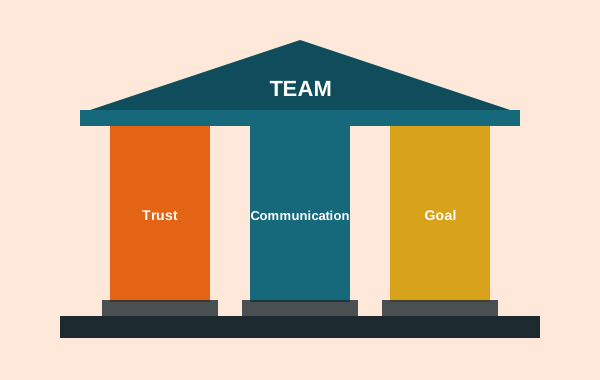
Which questions are suitable depends on the goal. The three pillars of trust, communication and a shared goal, which we describe in detail in our guide to the rules for good teamwork, provide ideas. If the team is newly formed or caught up in conflicts, it also helps to look at the stages of team development.
Choosing a provider: criteria and questions to ask about a quote
The market for team events is large and confusing. Besides price, pay particular attention to whether a provider understands your goal and delivers a genuine debrief. These criteria help you compare:
| Criterion | Good sign | Warning sign |
|---|---|---|
| Goal orientation | Asks about occasion, team and goal first | Immediately sends a catalogue with a price list |
| Methodology | Explains how the format contributes to your goal | Only promises fun, no learning element |
| Debrief | Fixed reflection part with experienced trainers | Reflection "optional" or not planned at all |
| Experience | References with similar group size and industry | No verifiable references |
| Scalability | Format works for your group size, hybrid too if needed | A large group is simply split into many unconnected small groups |
| Transparency | All extras, cancellation and bad-weather rules in writing | "From" prices without a breakdown |
| Inclusion | Alternative roles and low-barrier variants | Only physically demanding tasks |
Questions to ask about every quote
- Which services are included in the price per person – and which are not?
- Is there a minimum fee or a minimum number of participants?
- How many trainers will be on site, and what qualifications do they have?
- How long is the debrief, and how is the transfer into everyday work supported?
- What happens in bad weather, with last-minute cancellations or changes in the number of participants?
- Can the format be adapted to our topics – and what does that cost?
- Are the provider's travel, materials and insurance covered?
For comparison, it is worth looking at established providers. BITOU, for example, has been operating throughout Germany for more than 20 years, works with groups of 10 to more than 3,000 participants and delivers formats indoors, outdoors and virtually. There you will find an overview of directly bookable team building activities with a debrief, as well as the complete team building range, from short modules to multi-day programmes. If you are looking for longer-term support beyond a single event, team development at BITOU offers workshops and simulations for lasting change. Enquiries can be made by phone on +49 (0) 7643-935770.
Frequently asked questions about planning and costs
How much does a team event cost per person?
The cost per person depends mainly on the format: short team building games cost €0 to €5, a self-organised team day €20 to €80, a facilitated virtual event €30 to €90, a facilitated indoor or outdoor event €50 to €150, a workshop with a trainer €80 to €250 and a multi-day team trip €300 to €1,000 or more (all net, guide prices). Depending on the format, venue, catering and travel come on top.
How far in advance should you plan a team event?
For a one-day team event you should allow about eight weeks, and rather more in the peak season from May to September and in the run-up to Christmas. Short team building games in a meeting need hardly any preparation, whereas multi-day team trips often need three to six months.
Does team building count as working time?
If the employer requires attendance or the activity takes place during regular working hours, it is usually treated as working time. Voluntary events outside working hours are often assessed differently. What counts is the employment contract, any collective agreement and works agreements, and the rules differ from country to country; if in doubt, involve HR, the works council or legal advice.
How much can a team event cost tax-free?
In Germany, if the team event counts as a company event (Betriebsveranstaltung), benefits of up to €110 per participant including VAT remain free of tax and usually of social security contributions under Section 19(1) No. 1a of the German Income Tax Act (EStG), for a maximum of two events per year. Any amount above this is subject to wage tax. Rules differ in other countries, so check with a local tax adviser whether and how your event is covered.
How do I recognise a good team building provider?
A good provider asks about your goal before suggesting a format, plans a debrief led by experienced trainers, quotes transparent prices including all extras and has clear rules for cancellation, bad weather and accessibility. References from similar industries and group sizes are another good sign.
You might also be interested in
10 golden rules of teamwork
The 3 pillars of good collaboration, practical examples and a team agreement template.
See the rules →
Outdoor team building
Raft building, GPS rally and more: ideas for team events in the open air.
Outdoor ideas →
Virtual team building
Online formats for remote and hybrid teams – no travel and no venue costs.
Remote ideas →
Written by Joachim Grittmann, BITOU GmbH. For more than 20 years, BITOU has been designing and facilitating team building activities, team events and team development for groups of 10 to more than 3,000 people – experience from this practice feeds into the Teambuilding-Kompass.